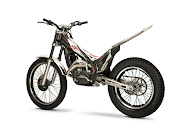
Beta’s proven experience over many years in the trials field (both in competition and production) has enabled Beta to develop an innovative design, light years away from the standards that have defined the concept of the “trials bike” up to now.
EVO (an abbreviation of evolution) achieved that objective with results exceeding even our highest expectations. Beta has built a bike aimed to represent the state of the art in lightness and dynamism. Starting from the frame design, Beta developed a brand-new concept, unheard-of in today’s trials bikes, and built the EVO around it.
The main technical features of the 2009 models both in 2 stroke version - 125cc, 200cc, 250cc and 290cc - and in 4 stroke version - 250cc and 300cc.
GENERAL FEATURES
The new frame, a single-beam aluminium chassis which simultaneously provides maximum rigidity and reduced weight represents the bike’s bone-structure and functions as its fuel tank.
Another important change, which has taken a long period of development, is a weight shift of the bike’s centre of gravity, raising it, in order to improve the bike’s dynamic behaviour. Here too, the results were striking.
The redesigned cycle parts contribute strongly to an improved riding feel. Key element is the rear shock absorber with progressive linkage. This centres the bikes mass along the EVO’s longitudinal and transverse axes.
The EVO features completely new bodywork. Particular attention has been placed in ergonomics as well as an overall reduction in dimensions and consequently weight.
The 2-stroke engine’s 290cc capacity is new, replacing the old 270cc. The engine is positioned higher in the frame improving rider feel.
The 2-stroke engines are equipped with a dismountable cylinder head, a new generator with dual mapping – soft or racing - and a new exhaust system with an expansion box as the first chamber.
The 4-stroke engines are equipped with a dual mapping control unit and a new exhaust system with a three-chamber mechanical silencer to combine performance with reduced noise output.
TECHNICAL INNOVATIONS
Cycle parts
- The innovative character of the single-beam aluminium frame, with its integrated fuel tank is based on a principal beam formed by extrusion. This houses the fuel supply, with forged crosspieces front and rear completing the structure.
Beta has optimised use of metal thickness and sections at points of maximum stress (finite element analysis was used for the frame calculations). This also allowed Beta to achieve targets in terms of lightness, rigidity and compactness not achieved in previous designs.
- The 38 mm forks are also new. They are the result of exclusive joint development by Beta and Paioli. The redesigned fork inner components are distinguished by the extensive use of light alloys and by sophisticated management of extreme hydraulic effects (damping). This is all fitted into a very light and compact design, with a 600 gram saving in weight. The result is a smoother and more progressive operation compared to any front suspension Beta has used in the past.
- The top yokes are now made from super-light aluminium fork, 150 grams lighter than in the past, fitted with pivoting single-fixing handlebar risers for easy and quick maintenance.
- The EVO’s wheels have been lightened, with new aluminium spoke-nipples, and lightened wheel-spindles fitted with more compact wheel bearings.
- The new aluminium swing-arm works by means of a progressive leverage system. Beta’s R&D department, using extruded and hydro-formed rails, designed this important element. This is a process that shapes the swing-arm by water-pressure, with a view to correct distribution of thickness so as to limit weight and increase rigidity.
- The new monoshock has an aluminium body with adjustment for spring preload and rebound damping.
- The rear brake system has been designed from scratch for EVO. The object was to reduce bulk and weight, at the same time increasing braking efficiency and precision. The rear master cylinder and its mounting to the frame are new, as is the calliper and its fixing system to the swing-arm. Furthermore, both the 160 mm diameter disc and the brake pedal are new.
- The engine protection plate is more rigid than in the past thanks to the insertion of reinforcing platelets between the frame forgings and the plate itself, the most stressed point.
- The electrical wiring system has been completely revised.
- The radiator is the result of fresh research. It now uses a different coolant circulation layout, designed to ensure greater cooling efficiency. It has a new temperature sensor mounted on the radiator.
- The air filter box also is based on a novel design concept, aimed at minimising pressure drops on the intake stroke and so maximising performance.
Engine
· · The choice of 290cc cylinder capacity was dictated by the search for greater versatility in use, to satisfy both competition riders’ need of performance and leisure riders’ request for more power and torque at low revs.
The power plant is located noticeably higher than in our earlier models, because of the benefits this brings to the bike’s dynamic behaviour by optimising the position of the centre of gravity.
· · The generator with its external pickup is new, with a higher power output and a programmable control unit with dual mapping (soft and racing) selectable by means of a switch.
· · The ignition casing has also been reshaped to accommodate the new ignition components.
· · The combustion components have been redesigned. The cylinder head can be dismantled into two pieces.
· · The conrod and the new piston are forged. Result: 30% less weight, to reduce reciprocating masses combined with a noticeable reduction in engine vibration.
· · Finally, the exhaust system has been reconfigured to feature an expansion chamber which combines better performance with an audible reduction in noise output.
TECHNICAL DATA
EVO 2T – 290cc 250cc 200cc 125cc
CHASSIS
Frame Single wave aluminium beam
Wheel base 1305 mm
Maximum length 1990 mm
Maximum width 850 mm
Maximum height 1115 mm
Seat height 660 mm
Ground clearance 310 mm
Footrest height 345 mm
Dry weight 69 kg - 68 kg for 125
Fuel tank capacity 2.6 litres
Reserve 0.5 litres
Cooling system 600 cc
Front suspension Hydraulic fork 38 mm shaft
Rear suspension Hydraulic monoshock with linkage
Shock stroke 60 mm
Front wheel travel 165 mm
Rear wheel travel 180 mm
Front brake 185 mm disc with 4 piston calliper
Rear brake 160 mm disc with 2 piston calliper
Front rim 21 – 1.6 – 32 spokes
Rear rim 18 – 2.15 – 32 spokes
Front tyre 2.75 x 21
Rear tyre 4.00 x 18
ENGINE BY BETA
Type - Single cylinder, 2 stroke,
liquid cooled, lamellar induction in crankcases
Capacity, bore, stroke
- 290 289.1 cc 78 mm 60.5 mm
- 250 249.7 cc 72.5 mm 60.5 mm
- 200 197 cc 64 mm 60.5 mm
- 125 124 cc 54 mm 54 mm
Compression ratio
- 290 9.5 : 1
- 250 8.9 : 1
- 125 14 : 1
Ignition Electronic AET 12V – 85W
Spark plug NGK BR7ES
Lubrication 70 : 1 full synthetic 2 stroke oil
Carburettor Keihin PWK 28 mm
Spark advance Variable 2 stage – soft or racing
Clutch Wet multi disc with cush drive
Primary transmission 20/71
Transmission 6 speed
Secondary transmission
- 290 11/42
- 250 11/41
- 125 9/43
Engine oil 550 cc
EVO 4T – 300cc 250cc
CHASSIS
Frame Single wave aluminium beam
Wheel base 1305 mm
Maximum length 1990 mm
Maximum width 850 mm
Maximum height 1115 mm
Seat height 660 mm
Ground clearance 310 mm
Footrest height 350 mm
Dry weight 72 kg
Fuel tank capacity 2.6 litres
Cooling system capacity 600 cc
Front suspension Hydraulic fork 38 mm shaft
Rear suspension Hydraulic monoshock with linkage
Shock absorber stroke 60 mm
Front wheel travel 165 mm
Rear wheel travel 180 mm
Front brake 185 mm disc with 4 piston calliper
Rear brake 160 mm disc with 2 piston calliper
Front rim 21 – 1.6 – 32 spokes
Rear rim 18 – 2.15 – 32 spokes
Front tyre 2.75 x 21
Rear tyre 4.00 x 18
ENGINE BY BETA
Type - Single cylinder, 4 stroke,
4 valves, chain driven single overhead
camshaft, liquid cooled, roller rockers
Capacity, bore, stroke
- 300 297.3 cc 84 mm 53.6 mm
- 250 249.6 cc 77 mm 53.6 mm
Compression ratio
- 300 11 : 1
- 250 11.5 : 1
Ignition Electronic
Spark plug NGK CR7EB
Carburettor Mikuni
Spark advance Variable 2 stage – soft or racing
Clutch Wet multi disc with cush drive
Primary transmission 18/63
Transmission 5 speed
Secondary transmission 11/42